

Ever wondered how some agencies seem to do it all, right down to providing their own web hosting? The secret is often white-label website hosting.
In simple terms, it's a service that lets you buy hosting resources from a provider and sell them to your clients under your own brand. Imagine you're a local coffee shop. Instead of growing and roasting your own beans (a massive undertaking), you buy premium beans from a top-tier roaster. You then package them in beautiful bags with your shop's logo and sell them as your own exclusive blend.
Your customers get amazing coffee and associate that quality with your brand, never knowing about the roaster behind the scenes. White-label hosting works the exact same way. Your clients see your brand, your pricing, and your support, while the provider handles the complex server infrastructure for you.
Understanding the White Label Hosting Model

At its heart, this is a business model designed to help agencies, freelancers, and even small businesses offer a new, valuable service without the headache of building it from the ground up. You’re essentially leasing server space and technology from a specialized company and presenting it to your customers as your own in-house solution.
The entire setup is built on the idea of rebranding. The hosting provider’s identity is completely hidden from your clients. From their perspective, they are logging into a control panel, paying invoices, and getting support from a system that is fully decked out in your company’s logo, colors, and unique brand voice.
The Core Components of White Labeling
This partnership lets you zero in on what you do best—building client relationships and scaling your business—while a dedicated team of experts manages the technical nitty-gritty.
Here’s what makes it all click into place:
- Branded Client Portal: You get a customizable dashboard where your clients can log in to manage their websites. Every pixel they see is branded as yours.
- Custom Pricing and Packages: You’re in the driver's seat. Create your own hosting plans, set whatever prices you want, and decide on your profit margins.
- Invisible Technical Management: The provider takes care of everything from server uptime and security patches to software updates and network performance. Your clients will never know they exist.
The real power of white label hosting is its ability to transform a technical, backend service into a seamless, brand-building asset. It allows you to add a high-value, recurring revenue stream while reinforcing your agency's authority and expertise in the digital space.
Why Rebranding Is Key
This whole concept hinges on successful rebranding. It’s about more than just sticking your logo on a generic service; it’s about crafting a client experience that feels completely authentic to your business.
To really nail this, it helps to understand the bigger picture. An Ultimate Guide to White Label Branding can shed more light on how businesses effectively resell third-party services as their own. Done right, this strategy positions you as the go-to, all-in-one partner for your clients' digital needs, which is a fantastic way to boost loyalty and lifetime value.
Key Business Advantages of White Label Hosting
Adopting a white label hosting model is much more than a simple technical switch. It's a strategic move that can completely reshape your business, turning a backend necessity into a powerful asset for growth. Instead of just building a website and then handing the keys over to your client, you're building a lasting partnership.
The most immediate change? A serious boost to your brand authority. When you're the one providing the hosting, you're no longer just the designer or developer. You become the all-in-one digital expert, the single point of contact for their entire online presence. This deepens client trust and makes their life a whole lot simpler.
Building a Predictable Revenue Stream
Let’s be honest, project-based work can feel like a feast-or-famine cycle. One of the biggest draws of white label hosting is the ability to build a steady, predictable, recurring revenue stream. This consistent monthly income is a game-changer for stabilizing your business.
The concept is simple: you buy hosting resources from a provider at a wholesale rate and sell them to your clients under your own brand at a retail price. That difference is your profit.
- Markup and Margin: You get to set your own prices. This gives you complete control over your profit margins, and many agencies find success by bundling hosting with other monthly retainers like maintenance or SEO.
- Automated Billing: The right platform can handle all the invoicing and payment processing for you. Once a client is set up, it becomes a hands-off income stream.
- Increased Lifetime Value: A one-off project fee is great, but a client paying you every single month? That dramatically increases their total lifetime value to your business.
This kind of financial stability makes it so much easier to forecast your revenue and invest confidently in your company's future. You can check out different white label pricing models to get a feel for how you could structure your own packages.
Strengthening Client Loyalty and Retention
Think about it: when you finish a project and send your client to a big-name hosting company, you’re essentially sending them to a competitor. White label hosting keeps them in your world, which is a massive win for client retention. When their website, support, and billing all come from you, there's far less incentive for them to ever look elsewhere.
This isn't a niche strategy anymore. The reseller hosting software market, which powers this model, was valued at $662 million in 2025 and is expected to climb to $975 million by 2034. Agencies everywhere are catching on to the power of keeping services under their own brand. You can learn more about the rise of reseller hosting solutions.
By managing the entire client experience, you eliminate the finger-pointing and confusion that happens when multiple vendors are involved. This streamlined service becomes a core reason clients stick with you.
At the end of the day, offering white label hosting shifts your client relationships from one-time transactions to long-term partnerships. It strengthens your brand, stabilizes your income, and creates happier, more loyal clients.
Comparing Different Agency Hosting Models
Picking the right hosting model for your agency isn't just a technical choice—it's a business decision that echoes through your branding, client relationships, and bottom line. There are a few well-trodden paths, but they lead to very different destinations in terms of control, workload, and the experience you deliver to your clients.
Let's break down the main contenders: white label website hosting, standard reseller hosting, managed hosting, and the full do-it-yourself (DIY) route. Each one offers a unique trade-off between convenience and control, and figuring out which fits best depends entirely on your agency's goals and technical chops.
This diagram shows how white-label hosting acts as a launchpad for growth, directly feeding into brand authority, predictable recurring revenue, and long-term client loyalty.
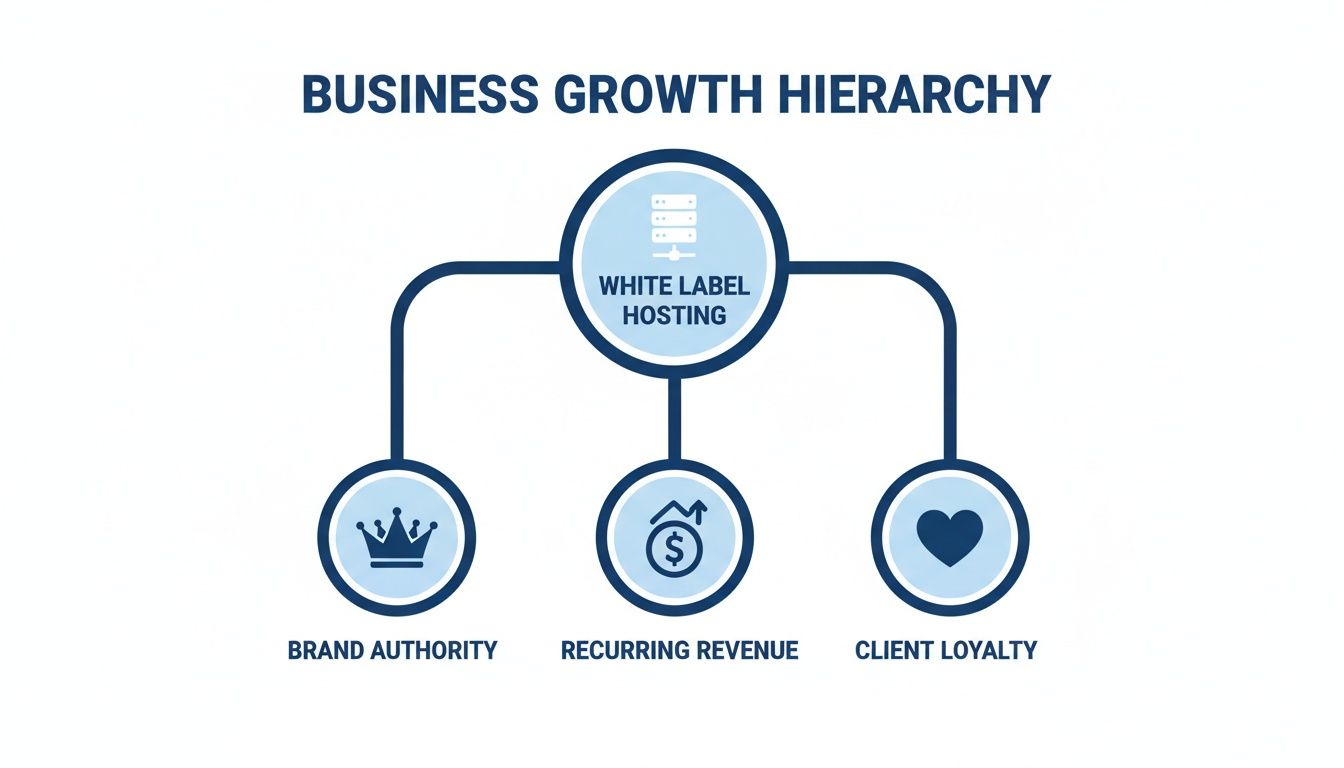
The takeaway here is that the right model turns hosting from a simple line item into a central pillar of your business strategy.
White Label vs Reseller Hosting
On the surface, white-label and standard reseller hosting look like twins. The crucial difference, however, is branding. With a standard reseller plan, the original hosting provider’s name often pops up somewhere, maybe in the cPanel or a support document. This tiny detail can shatter the illusion, confusing clients and chipping away at your brand authority.
True white label website hosting, on the other hand, makes the provider a ghost. They’re your silent partner, running the heavy machinery behind a curtain that’s completely branded as yours. Every touchpoint, from the login page to the email notifications, features your logo and your name. This creates a seamless experience that reinforces your clients' trust in you as their one and only provider.
Managed Hosting vs Self-Hosting
At the other end of the spectrum, you have managed hosting and the classic DIY approach.
Going the DIY self-hosting route means you lease a server and run the whole show yourself. This gives you absolute control, but it's a huge commitment. You'll need serious sysadmin skills, be ready for 24/7 monitoring, and take full responsibility for every security patch, update, and late-night server crash. It’s a high-stakes game best left to agencies with a dedicated technical team.
Managed hosting is the hands-off alternative. The provider takes care of all the server maintenance, security, and updates, which is great. The downside? You typically can't rebrand it or sell it to your own clients. It’s perfect for running a single, important website but doesn't give you the tools to build a hosting business. Many are also finding simpler solutions like static website hosting for specific projects.
The Strategic Balance: White label hosting hits the sweet spot. You get the complete brand ownership of a DIY setup without the crushing technical overhead. For agencies focused on growth and client relationships, it's the smartest move.
Agency Hosting Models Compared
To really see how these options stack up, it helps to put them side-by-side. The table below breaks down the key differences to help you decide which path is right for your agency's needs.
| Feature | White Label Hosting | Standard Reseller Hosting | Managed Hosting | Self-Hosting (DIY) |
|---|---|---|---|---|
| Branding Control | 100% Your Brand | Partial (Provider visible) | None (Provider branded) | 100% Your Brand |
| Technical Workload | Low (Provider handles) | Low (Provider handles) | Very Low | Very High (You handle all) |
| Client Ownership | Complete | Complete | None | Complete |
| Profit Margin | High (Set own prices) | Medium | N/A | Highest (If managed well) |
| Best For | Agencies focused on branding and client relationships. | Agencies starting out with a limited budget. | Single businesses with high-traffic websites. | Highly technical teams with sysadmin expertise. |
Ultimately, the choice comes down to what you want to be for your clients. Do you want to be a service reseller, or do you want to be their all-in-one digital partner? White label hosting is built for the latter, giving you the foundation to scale without the technical headaches.
What to Look For in a White Label Hosting Provider

Choosing a partner for your white label website hosting is a make-or-break decision for your agency. The truth is, not all providers are built the same, and picking the right one can be the difference between scaling smoothly and dealing with constant fires. This isn't just a vendor checklist; it's a guide to the absolute non-negotiables your business needs to thrive.
The entire white-label model works only if your provider is a true silent partner. That starts with a 100% brandable client portal. Your clients should log in and see your logo, your colors, your name—and nothing else. The moment they see another company’s branding, the magic is gone, and so is a little bit of your credibility.
Rock-Solid Security and Reliability
Once you've nailed the branding, the actual hosting service has to be bulletproof. Remember, your agency's reputation is directly tied to the performance of every client site you manage. That makes top-notch security and uptime non-negotiable.
You need a partner who bakes a full security suite into their standard package. Look for these essentials:
- Automatic SSL Certificates: Every single site needs to be secured with HTTPS right out of the box. No manual work, no extra fees. It should just happen.
- Proactive Malware Scanning: The best defense is a good offense. Your provider should be actively hunting for and shutting down threats before you or your clients even know they exist.
- Guaranteed Uptime SLA: A Service Level Agreement (SLA) is more than a pinky promise; it’s a contractual guarantee. A solid SLA means the provider has skin in the game, protecting both your clients' businesses and your good name.
A strong SLA is your insurance policy. It ensures the provider is financially motivated to maintain a stable environment, which is crucial for retaining clients who depend on their website being online.
Scalable Resources and Expert Support
Your agency is built to grow, and your hosting partner needs to be ready to grow with you. A great white-label provider offers an easy and clear path to scalable resources. You should be able to upgrade a client's plan or add more power with just a few clicks—no messy migrations or dreaded downtime.
Equally important is the team backing you up. When a client calls with a tricky technical problem that's over your head, you need experts in your corner, and you need them fast. Prioritize providers with 24/7 technical support from a team that gets the white-label dynamic. They become your secret weapon, your behind-the-scenes crew that helps you solve anything while you stay the hero in your client’s eyes.
The demand for reliable, brandable hosting is exploding. The global web hosting market is projected to hit a staggering USD 527.07 billion by 2032, fueled by agencies and small businesses just like yours. You can find more data on the booming web hosting market. By choosing a partner with these must-have features, you're not just buying a service; you're positioning your agency to claim your piece of that massive opportunity.
How to Launch Your Branded Hosting Service
Thinking about offering hosting under your own brand? You might be surprised at how quickly you can get it off the ground. With the right platform, you can go from an idea to a live service in just a few hours. Let's walk through the exact steps to make it happen, turning a smart strategy into a real, money-making part of your business.

The first thing to do is pick a plan that makes sense for you right now, but also gives you room to grow. Don't go overboard and buy more than you need. The key is to find a package that handles your current clients comfortably and offers a simple upgrade path for when your hosting business takes off.
Step 1: Choose Your Plan and Brand Your Portal
After you've signed up with a provider, the fun begins: making the service look and feel like it’s yours. This is the heart of white-label website hosting.
Getting your brand in place is usually a breeze. You’ll just need to:
- Upload Your Logo: Swap out the provider's logo for yours in the client dashboard, emails, and everywhere else your clients will see.
- Set Your Brand Colors: Tweak the color palette of the control panel to align with your company's branding.
- Configure Your Custom Domain: Point a custom domain or subdomain (like
clients.youragency.com) to the client portal. This step is what makes the experience totally seamless.
This initial branding work is what makes the hosting provider invisible. It solidifies your position as the go-to partner for all your clients' digital needs.
Step 2: Create and Price Your Service Tiers
With your branded portal up and running, it's time to decide what you're actually going to sell. A one-size-fits-all plan is a missed opportunity. Instead, create a few different packages to meet various client needs and budgets—it’s a classic, effective way to maximize your revenue.
A three-tier structure is a solid starting point for most agencies:
- Starter Plan: A basic package for small brochure sites or simple portfolios.
- Growth Plan: The perfect middle ground for businesses that are starting to see more traffic and need more resources.
- Scale Plan: A premium option built for e-commerce stores or large websites that demand high performance.
Your pricing strategy is where you turn this into a profitable venture. Figure out your wholesale cost per client, then add your margin. A 50-70% profit margin is a common and healthy target for hosting. Many agencies find success by bundling hosting into their monthly retainers, too. For more ideas on this, check out our guide on how agencies can build recurring revenue.
Remember, you're not just reselling server space. You're selling peace of mind—a fully managed, hassle-free experience backed by your expertise. Your prices should reflect that value.
Step 3: Market Your New Hosting Service
Okay, your service is built and ready to go. Now you need clients! Your existing customer base is the perfect place to start; they already know and trust you. You can pitch it as a simple way to streamline their operations by bringing everything—design, development, and hosting—under one roof.
You're also tapping into a major market shift. By 2025, it's expected that over 65% of users in the reseller hosting world will choose white-label options to brand their services. This is part of a bigger trend, with the entire reseller hosting market projected to reach $662 million by 2025. When you offer a branded service, you're meeting a real, growing demand. You can explore the latest web hosting statistics and trends to see just how big the opportunity is.
For new clients, make your hosting a core part of your pitch. Highlighting the benefit of having a single point of contact for everything related to their website is a huge selling point. It builds trust and makes the entire relationship simpler from day one.
Common Questions About White Label Hosting
Thinking about offering white label hosting is a smart move, but it's totally normal to have a few questions before you jump in. Agency owners and freelancers often ask us about the nuts and bolts—who's on the hook when a server goes down at 3 AM? And how do you actually make money doing this?
Let's clear up the most common questions. Getting these answers straight will give you the confidence to know you're making the right call for your business.
Who Handles Technical Support for My Clients?
In short, you do—but you've got backup. With a white label setup, you're the face of the operation. You handle the billing questions and day-to-day support, which is great for building strong, lasting relationships with your clients. They see you as their all-in-one expert.
But what about the really tricky stuff? For complex server problems, weird performance hiccups, or security alerts, you have a direct line to your provider's team of experts. They act as your silent technical crew, working behind the scenes to fix things. You get to be the hero who solves the problem, while we handle the heavy lifting.
How Complicated Is Migrating Client Websites?
This is a huge point of anxiety for a lot of people, but it's usually much simpler than you'd think. The idea of moving a bunch of client sites sounds like a weekend-long headache, but you don't have to do it alone.
Any decent white label host will offer free, managed migration services to get you started. Their whole job is to move websites—files, databases, all of it—without causing downtime. You just grant them access, and they handle the technical transfer. It’s a smooth, seamless process for both you and your clients.
The best white label partners don't see migrations as a problem to solve; they see it as part of the welcome package. They want you on their platform with zero friction, because when you succeed, they succeed.
Can I Really Set My Own Prices for Profit?
Absolutely. This is where the business model really shines. White label website hosting means you buy hosting from your provider at a wholesale rate and then decide what to charge your clients. The difference is your profit. Simple as that.
Many successful agencies don't just sell hosting on its own. They bundle it into a monthly care plan that might include things like:
- Site maintenance and updates
- SEO check-ins
- Content changes
This approach is brilliant for a couple of reasons. First, it creates predictable, recurring monthly revenue you can count on. Second, it makes you an essential partner to your clients, dramatically increasing their lifetime value to your business.
Will This Solution Scale as My Agency Grows?
Yes, any good white label platform is designed to grow with you. You're not locked into a single, rigid plan. You can start with a package that fits the handful of clients you have today and then easily upgrade as you land more projects.
Need more storage? More bandwidth? More client slots? You can add resources on the fly, often instantly, without any service interruptions. This "pay-as-you-grow" approach means you're never paying for more than you need, ensuring your hosting business stays profitable at every stage.
Ready to add a profitable, brand-building service to your agency? With Hostmora, you can launch your own white-label hosting in minutes. Check out our agency solutions and see how easy it is to get started.